Living in a free society brings both privileges and responsibilities. Among the most important is the right to vote. It is one of the few opportunities each of us has to help shape the future of our communities, our state, and our nation.
For some, voting is simply a civic duty. For others, it is also an expression of faith and a commitment to the common good. Regardless of our backgrounds or beliefs, we share a responsibility to be informed, engaged, and concerned about the well-being of those around us. By participating in elections, we exercise both a right and an important responsibility.
As citizens, we have the opportunity to influence the direction of our communities through thoughtful participation in the process. Whether our priorities center on family, education, public safety, economic opportunity, or individual liberty, voting provides a meaningful way to make our voices heard.
For people of faith, voting can also reflect a desire to live out values such as compassion, integrity, and concern for others. Prayer may guide the process. For those who do not practice a faith tradition, reflection on principles and convictions can serve the same purpose. In either case, voting should be approached with sincerity, respect, and a genuine concern for the common good.
Our constitutional republic depends not only on our freedoms, but on our participation. We may differ on issues and candidates, yet we all benefit when citizens engage thoughtfully and respectfully for the founding principles of our country. Healthy communities are built not through uniformity of opinion, but through a willingness to listen, learn, and participate.
As a new week begins, take time to learn about the issues, consider the needs of others, and make a plan to cast your ballot. Good citizenship is measured by our willingness to engage responsibly in the life of our nation.
May God grant us wisdom where choices are difficult, humility where opinions differ, and a spirit that seeks the welfare of our neighbors and communities. And may we never take for granted the freedoms and liberty our founders bestowed upon us or the responsibilities that accompany them.
For in caring about the future of our communities, we demonstrate our concern for one another, and in participating thoughtfully and respectfully, we help build a future that reflects our highest ideals and our shared hopes of our republic for generations to come.
On Halloween Eve, I’ve written about Orson Welles and his broadcast of The War of the Worlds, and linked the radio broadcast. Sticking with it for the most part, here is a shortened version of The War of the Worlds history, with a real-life second part added. Part 1: Martian Panic, Edgar’s Dummy, and a Pair of Shoes
On Halloween Eve 1938, a 23-year-old Orson Welles broadcast his now-famous War of the Worlds radio play. Was there a legal issue? Minor ones, mostly. The strange part is the show had been publicized in newspapers beforehand, proving people’s gullibility hasn’t changed much over time.
Despite three explicit disclaimers during the broadcast stating the Martian invasion was fiction, headlines the next day exaggerated claims of widespread panic and terror. In reality, the audience was small. Most listeners were tuned into ventriloquist Edgar Bergen and his famous dummy, Charlie McCarthy.
Threatened lawsuits followed, but almost all were dismissed. CBS settled a few minor claims, and Welles reportedly bought a new pair of shoes for one listener who claimed he’d spent his shoe money on a train ticket to flee the Martians. Welles’s notoriety paid off. Three years later, he co-wrote, directed, produced, and starred in Citizen Kane, winning an Oscar for Best Original Screenplay.
Part 2: Living the Panic 46 Years Later
I was always well aware of the War of the Worlds history, though I obviously wasn’t born when it aired. What was strange was experiencing that exact same psychological phenomenon firsthand, forty-six years later.
On Sunday evening, April 29, 1984, NBC re-aired Special Bulletin, a realistic TV movie shot to look like a live breaking news report about a nuclear submarine crisis in South Carolina.
I happened to be driving that night toward a small motel 180 miles away to start a new job the following morning. Unaware of the movie, I called the motel’s front desk from the road to say I was on my way. The owner, an older woman, answered in a full-blown panic. She was 100% convinced the nuclear crisis was actually happening.
I flipped through radio stations as I drove, but found nothing. I called her back to explain the radio was quiet, but she was still watching her TV and even more panicked than before.
When I finally arrived, the show was still on. She invited me in to watch, and I stood in her living room taking in the screen. It looked remarkably real, but key details didn’t add up—starting with the network’s call letters, which weren’t ABC, CBS, or NBC. When the on-screen disclaimer finally appeared, I pointed out that it was just a fictional docudrama. She still refused to believe me.
It’s amazing what the mind can do when a broadcast tells it to panic—and sitting in that motel living room in 1984, I felt like I had stepped right into 1938.
No one can be forced to believe in God. Belief is not something that can be argued, pressured, or replaced by good works. The choice to turn away is real, and it is your choice, not God’s, that leads to an eternity of separation from Him. Psalm 14 reminds us that the claim “there is no God” is often spoken even after people have been exposed to the truth. But it also leaves room for the possibility that hearts can change. God respects people’s freedom by not coercing them, but He can still work with those who are open to Him. The door to salvation stays open only in this life.
As the election approaches, it’s common to hear reasons why people choose to sit it out. Frustration with politics is real, but as believers, our civic participation rests on spiritual principles rather than temporary feelings.
Here are common objections people raise.
My preferred primary candidate lost:
Well, voting is not a declaration of affection for an individual. It is a decision on policy direction, judicial appointments, and societal governance.
It feels like choosing the lesser of two evils:
I hear this one a lot. In a fallen world, every leader is flawed. Waiting for a morally flawless political figure with this mind means never participating at all. Unless Christ Himself is on the ballot, a perfect candidate will never exist. If viewed as choosing the lesser of two evils, common sense tells us to choose the option that limits harm and promotes the greatest good. For the believer, that choice is accompanied by lifting that leader up in prayer; for others, it should bring peace in knowing the best possible choice was made for the community.
God is sovereign over rulers anyway:
I think this explains why some Christians choose to sit out voting. It is true of course but divine sovereignty never absolves believers of personal responsibility. God commands us to act, pray, and seek the welfare of our community.Those who say it is God’s will are right only in part. Divine preeminence never absolves believers of personal responsibility. God does not tell us to sit back and do nothing; He commands us to act, pray, and seek the welfare of our community as we work for His glory.
My single vote doesn’t matter:
Not true of course. Many critical local decisions on school boards, budgets, and judges are decided by remarkably slim margins.Think about this for a moment; history proves otherwise. In the 1960 presidential election between John F. Kennedy and Richard Nixon, the election was decided by a margin averaging fewer than two votes per precinct nationwide. On both national and local levels, single votes have decided critical outcomes. It’s why we use coin flips to break a tie when the election should have been decided by those staying home because their vote didn’t matter.
The system feels corrupt or broken:
It probably is and needs to be fixed. But you don’t fix it by staying home. Withdrawing surrenders all influence to those who may actively promote harm or restrict freedom. If you’re not part of the solution, you’re part of the problem.
Feeling unprepared or uninformed:
That’s on you. In Proverbs, we’re told seeking wisdom and researching issues is part of faithful stewardship. By the way, I’ve used stewardship a few times because I find it Biblically based, but think of it in terms of responsibility, accountability, or moral duty.
How does Scripture shape our response?
Voting is an Act of Stewardship
In the Parable of the Talents, Jesus teaches that we are held accountable for what has been entrusted to us. In a republic, political influence is a tool given to citizens. Choosing not to participate is like burying that tool in the dirt out of frustration instead of using it to influence society for good.
Seeking the Best for Your Community
God calls His people to seek peace and prosperity for where they live. Voting is one direct, accessible way to influence local and national decisions that impact schools, public safety, economic stability, and freedom of worship. And yes, freedom to worship, in my opinion, is on the ballot this year.
Voting as Direction, Not Endorsement
Recall from above, a vote is not a declaration of personal affection or spiritual endorsement for a candidate. In a fallen world, every leader is imperfect. Scripturally, choosing to limit harm and promote policies that align closest with justice, mercy, truth is an act of wisdom. Our ultimate hope never rests in earthly governments. Our ultimate citizenship is in Heaven. However, our temporal responsibility is to be faithful stewards right where God has placed us today. Pray for wisdom, engage with purpose, and use your influence to serve your neighbors and country well.
Does viewing your vote as an act of serving God change the way you approach election season? Feel free to share your thoughts in the comments.
To my brother-in-law, Denny, for pointing out to my wife, Dawn, Romans 1:1 to 21 which directly underscores and expands on the main points in this reflection.
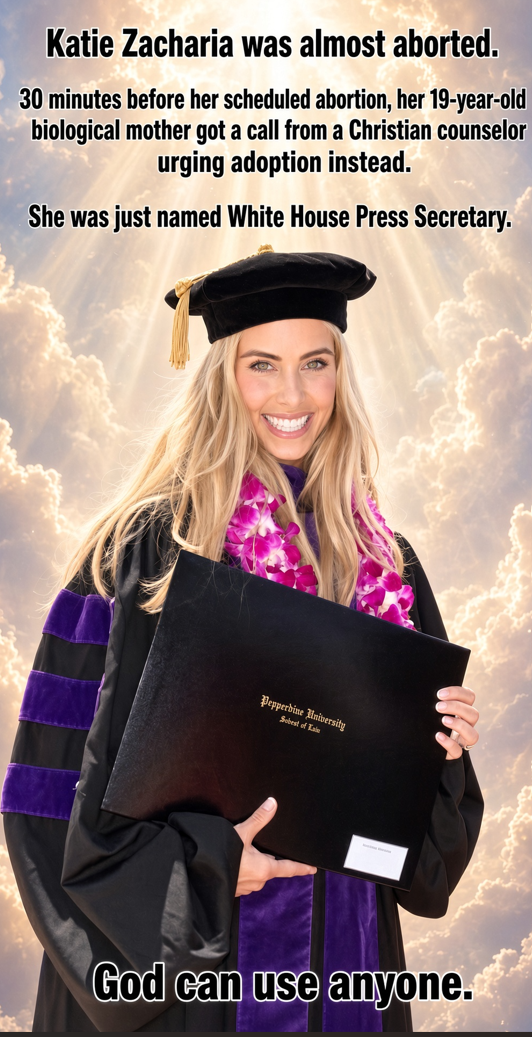
I recently read the story of Katie Zacharia, who has publicly shared that she was approximately 20 to 30 minutes away from a scheduled abortion when a Christian counselor called her biological mother and encouraged her to consider adoption instead. Katie was placed for adoption as a newborn and later met her biological mother as an adult.
Today, many people know her because of her public career, but that is not what stands out to me.
What stands out is a phone call.
One person took the time to reach out. One mother made a difficult decision. One child was given a chance at life. None of them could have known what the future would hold.
Some see coincidence. I see God’s hand at work.
Scripture tells us that God knows us even before we are born. I cannot help but think of Jeremiah 1:5: “Before I formed you in the womb I knew you.” If that is true, then God already knew the plans He had for her life long before anyone else did.
To me, this is a reminder that God can use ordinary people in extraordinary ways. A conversation. A phone call. A word of encouragement. We may never know how God will use our actions or how far their impact may reach.
That is why I see stories like this as a testament to God’s providence. The counselor likely had no idea what would become of that child. The mother could not see decades into the future. But God could.
Sometimes a single decision can change the course of a life; maybe the world.