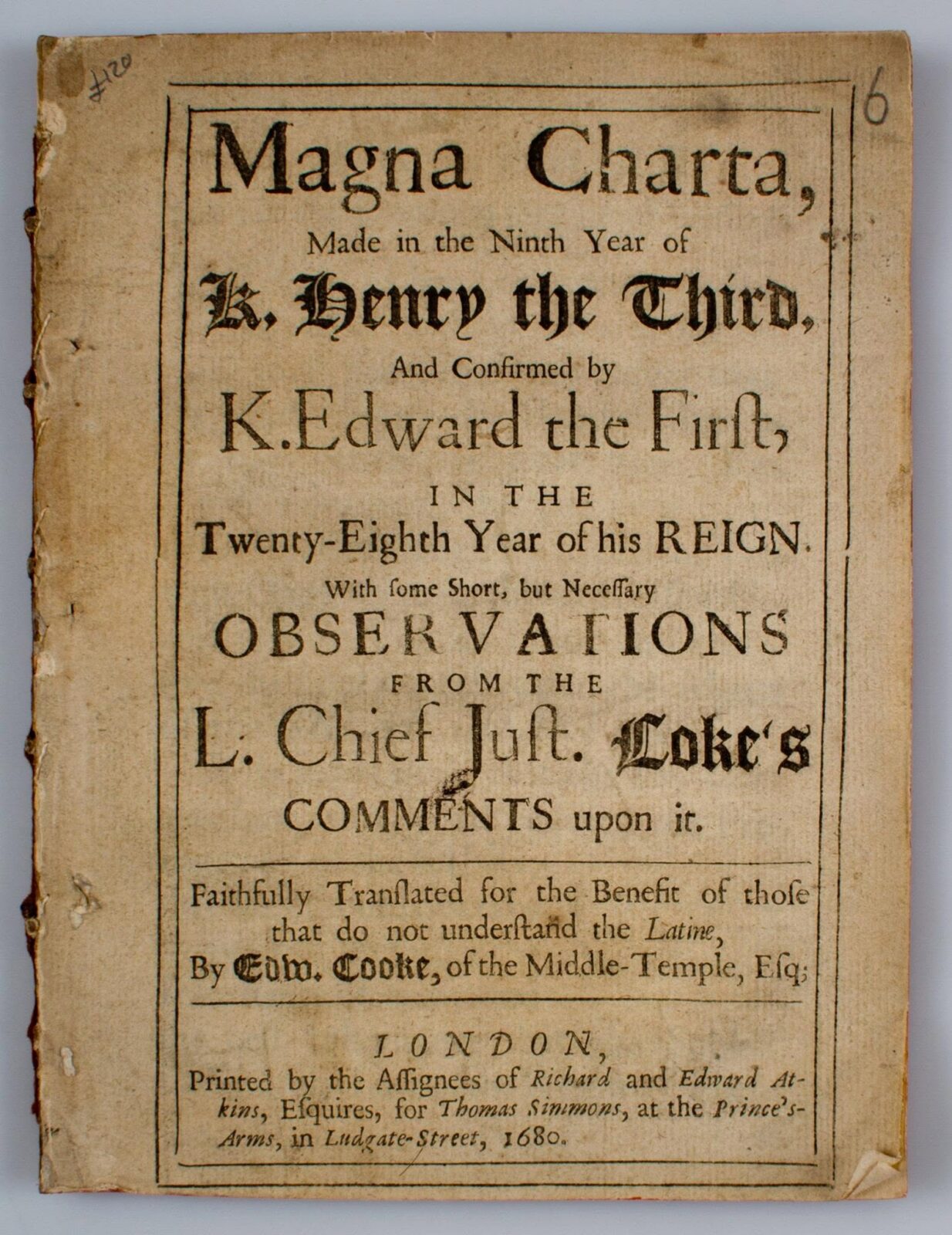
Today is the 811th year anniversary of the Magna Carta (not Charta), Latin for the Great Charter. It’s a somewhat unusual document because the original was really an agreement between King John of England and the nobility. However, from year to year, revisions were made. Some historians believe the nobility were not simply representing themselves but were, in a broader sense, representing the people of England. What does not seem in dispute is that English colonists carried its ideas across the Atlantic, wrote colonial charters with its principles in mind, and eventually saw some of its provisions echoed in the United States Constitution.
Over time, the Magna Carta became more than a peace treaty between a king and his barons. It evolved into a symbol of the principle that even the sovereign must obey the law , the beginnings of the rule of law. Later generations, especially in the 17th century, treated it as a foundational guarantee of individual rights, even though the original document was far narrower. Thinkers like Sir Edward Coke cited it as proof that English liberties were ancient and inviolable, helping transform a political compromise into a constitutional touchstone.
By the time English settlers arrived in North America, the Magna Carta had taken on a life of its own. Colonial assemblies, charters, and later revolutionary leaders drew on its language about due process, limits on arbitrary power, and the right to judgment by one’s peers. When the framers drafted the Constitution and the Bill of Rights, they borrowed directly from these inherited principles, especially in protections like habeas corpus, trial by jury, and constraints on executive authority. In that sense, the Magna Carta’s legacy is not that it solved the problems of 1215, but that it planted ideas that would shape constitutional government centuries later.
And here we are, in less than a month, celebrating 250 years since issuing our own indictment of England and declaring independence, leading to the United States of America. The men who gathered in Philadelphia in 1776 did not see themselves as inventing liberty from scratch. They believed they were asserting rights that were already theirs as Englishmen, rights rooted in centuries of tradition, including principles first expressed in the Magna Carta. When Jefferson wrote that the king had violated the laws of nature and of nature’s God, he was also drawing on the long standing belief that rulers were bound by law and not above it.
The Declaration of Independence became, in a sense, America’s own great charter, a statement that government exists by consent, that power has limits, and that people have the right to alter or abolish a government that violates those limits. It was the culmination of ideas carried across the ocean, reshaped by colonial experience, and sharpened by conflict. And just as the Magna Carta grew far beyond its original purpose, the Declaration grew into a universal statement of human liberty, influencing constitutions and movements around the world. For Americans, it remains the moment when inherited rights became self government and when a set of principles became a nation.