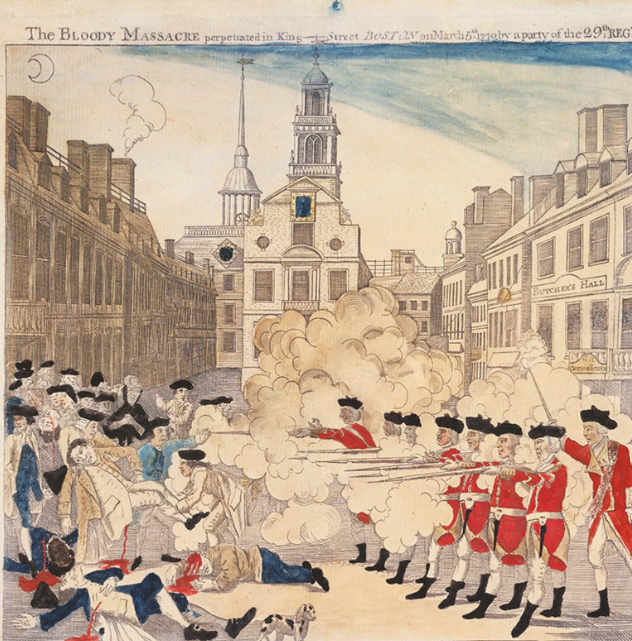
The Boston Massacre – March 5, 1770
Five men were shot and killed in Boston.
A crowd of angry Bostonians had been taunting a small squad of British soldiers, pelting them with snowballs, rocks, and throwing in some insults. In the chaos and, probably fear, the soldiers fired into the crowd. It’s not Black History month, nor does it need to be, but Crispus Attucks, a black sailor, is determined to be the first to fall dead. The city erupted in outrage.
The British soldiers were arrested and charged with murder.
Then it gets interesting. In a time when mob justice would have been easy, one man, an attorney, stepped in to defend them. John Adams, a rising patriot lawyer and cousin of Samuel Adams, a patriot as well, and a bit of a rabble rouser, a leader of the Boston Tea Party.
The story is Sam asked cousin John to defend the soldiers This raises a question in my mind but, John Adams took the unpopular case. He believed that if the American cause was to be just, it must rest on the rule of law, even for British soldiers. In a powerful closing argument, he told the jury that facts, not passion, must decide the matter. It’s still supposed to work that, except today on social media. and in some court cases, people are left wondering.
Anyway, the result stunned people. Six of the soldiers were acquitted. Two were convicted of the lesser charge of manslaughter.
John Adams later called it “one of the most gallant, generous, manly and disinterested actions of my whole life.” It cost him clients and popularity in the short term, but it strengthened the moral foundation of the patriot cause.
How did Sam feel? Well, he wanted cousin John because he wanted the soldiers to have a good defense. The only thing I know he wasn’t expecting it, so probably not pleased. He was hoping for a guilty verdict.
By the way, here’s something interesting, but it makes no sense to me. The two found guilty faced the death penalty but they “prayed clergy,” a legal loophole that allowed first‑time offenders to avoid execution by demonstrating literacy in a biblical verse, that meant being able to read one. It was reserved for members of the clergy initially but expanded. Once accepted, the court commuted their sentence to branding with a hot iron, marking the letter M for manslaughter or murder on the thumb. In other words, on a first offense, you’d escape the death penalty if literate enough to read a Bible. Fail and you get hanged.
This was five years before Lexington, the topic of the third of these. So, the rule of law principle was tested; a free people must be governed by law, not vengeance.
[As an aside, the Boston Massacre (March 5, 1770) and Kent State (May 4, 1970) are almost exactly 200 years apart, and a parallel has been drawn by many writers over time. It’s a powerful one if framed as both involving government forces firing on civilians, both becoming instant propaganda symbols, and both raising questions about authority, protest, and lethal force. I reject the idea of similarity. I’ve written in detail about Kent State every May 4th for years, but I stopped writing about it with my last one, vowing to never again write about it. But I believe there are differences.]