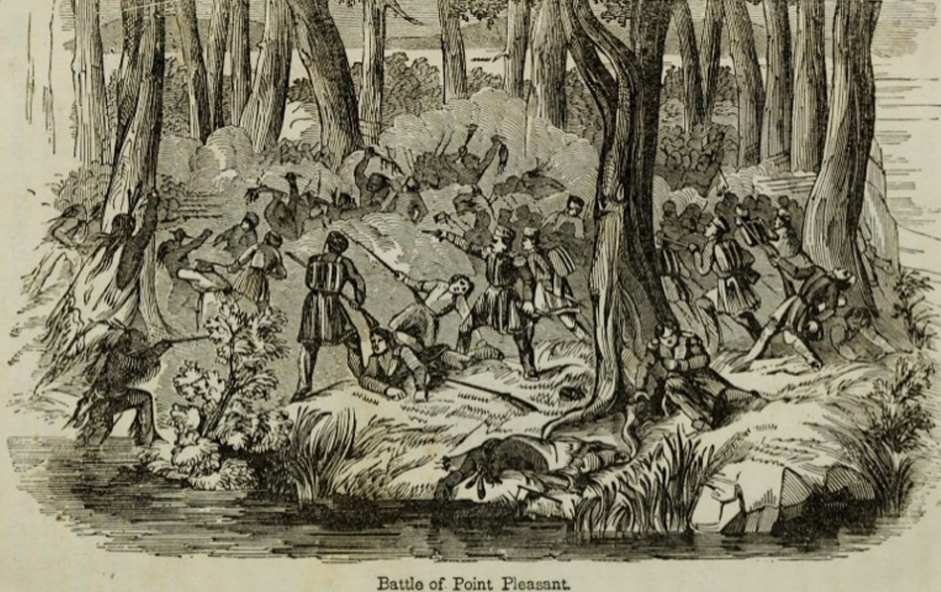
My guess is many have not heard of this battle and for some the tie to the Revolutionary War is tenuous, but I’ll try to piece it together. Whether I do or not, many West Virginians claim the battle was the first shot fired for the fight for independence. My interest comes from family reunions on Frazier Mountain close to Nitro, West Virginia. Plus, I’ve always loved history,
So, about six months before Lexington and Concord, more associated with the beginning of the revolution, the first real blood of the coming war was shed on the banks of the Ohio and Kanawha Rivers at Point Pleasant in what is now West Virginia.
More than a thousand Virginia (West Virginia wouldn’t exist as a state until about 90 years later during the Civil War) militiamen had camped at the Point, a narrow spit of land where the two rivers meet. At dawn, they were attacked by roughly 700–1,000 Shawnee and Mingo warriors led by the Shawnee Chief Cornstalk. As an aside, during the French and Indian War, Cornstalk fought with the French against the British. During the Revolution, he fought with the British against the colonists.
The fighting was brutal and lasted most of the day. It was often hand-to-hand. The Virginians held their ground against repeated charges, finally driving the warriors back across the Ohio River. In fact, the Virginians suffered staggering losses, probably more than the combined forces of the Mingo/Shawnees. The Virginia militia suffered 215 total casualties, 75 killed and 140 wounded. There are no reliable sources of Mingo/Shawnee losses, but estimates range from 60-100 killed. For Virginia, the numbers may not seem large, but those casualties represented about 20% of the total number of militia in one day.
Some West Virginians have long claimed this was the true first battle of the American Revolution. British Royal Governor Lord Dunmore was accused of encouraging, or at least failing to restrain, the tribes in order to weaken the frontier colonies. That cannot be proven as true. But keep it in mind. Dunmore had British regulars available for what was known as Dunmore’s War but held this to be a local matter. In fact, the entire Dunmore’s War, including the Battle of Point Pleasant, was fought solely by American colonial militia with no British regulars involved.
Dunmore’s War and Point Pleasant were like a “warm-up” conflict on the frontier. It trained many future Revolutionary soldiers, secured the western border temporarily, and occurred right on the eve of the war for independence. It gave Americans combat experience against irregular warfare, knowledge of fighting in woods and rough terrain, and a strong independent spirit. Many of the Virginia militia joined the Continental Army, and Dunmore earned the scorn of colonists.
Today a granite monument and museum stand at the battlefield in Point Pleasant. For those whose families have roots in the Ohio Valley, It was not yet the Revolution. But it was the sound of America realizing it would have to fight.